Don't Dread Indoor Pools
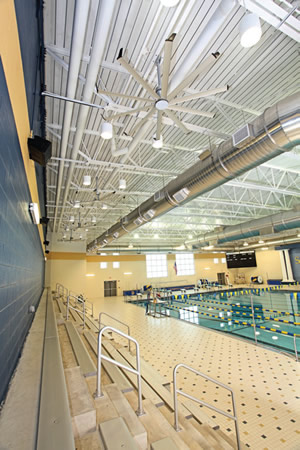 Indoor swimming pools are a great asset for schools — until they’re not. Natatoriums offer year-round sports and fitness opportunities and can attract new students looking for a school with a swim facility, but they also require frequent maintenance and are difficult to keep comfortable. They tend to lack air movement, leaving them stuffy and often too warm for swimmers and spectators alike. Additionally, chloramines from the chlorine-laden water can build up in the air near the pool surface, irritating swimmers’ eyes and noses and contributing to that distinctive (and undesirable) pool odor.
Large overhead fans can significantly improve comfort and air quality in indoor pools. According to the Centers for Disease Control and Prevention, “improving air movement over the pool and increasing the air turnover rate will reduce irritant levels in the air. One option is to … use fans to boost airflow over the pool surface when many swimmers are using the pool.” High-volume, low speed fans are the most effective way to get air moving in a large, open space like a natatorium, and they can provide an energy efficient way to improve comfort as well as air quality.
Keep it cool: When Maine-Endwell High School in Endwell, N.Y., decided to replace their non-conditioned aquatic center, the top priorities were comfort and energy efficiency. Four 8-footdiameter fans were installed above the bleacher area of the new space, making spectators feel cooler and promoting air circulation throughout the entire facility. The fans also contributed to the school’s overall sustainability efforts, providing energy-efficient comfort in a hard-to-cool space.
Give your dehumidifier a break: Built in 1971, the indoor pool at Central High School in Louisville, Ky., relied on an outdated, costly dehumidification unit that made it even more challenging than normal to maintain consistent temperature and sufficient air quality in the space. The school installed an 8-foot-diameter fan over the large swimmer’s deck. The air movement from the fan created a cooling effect for swimmers and spectators and contributed to air quality and energy savings. “The fan helped improve the air turnover rate, which enabled us to save money upfront by installing a smaller dehumidification unit,” said James Troutman, a consulting engineer on the project. “The fan keeps humidity levels low and reduces condensate issues while also decreasing the load on the system.”
Tell chloramines to get lost: George Mason University in Fairfax, Va., installed two 24-foot-diameter fans to provide muchneeded airflow in its Freedom Aquatic and Fitness Center. Officials at the school believe the fans have helped circulate the heavier chloramine-laden air so it can reach the ventilation system and exit the space, making the natatorium healthier for swimmers. The efficient fans contributed to the green initiatives already in place at George Mason, decreasing the university’s overall energy consumption while increasing comfort in the aquatic center.
This article originally appeared in the issue of .
About the Author
Thomas Lesser is a research and development engineer with Big Ass Fans.