Bright Ideas
- By Imke Wies van Mil, Anne Iversen, Jakob Strømann-Andersen
- 03/01/16
PHOTOS © HUFTON + CROW
The contemporary learning experience has become radically diverse. Instruction can take the form of extemporaneous discussions; formal lectures; or virtual, Internet-based education. The variety isn’t limited to teaching techniques — it extends to architectural environments, as well. The conventional classroom has been supplemented by set-down spaces, communal or team-oriented gathering areas and individual workstations for connecting online.
There is, however, a common denominator to all these scenarios: effective lighting design. Research indicates there is a strong correlation between light and learning, and certain lighting conditions are proven to positively affect performance and functioning.
In years past, simply flipping on the overhead fluorescents was the extent of classroom lighting. Today, sophisticated technologies allow natural daylighting to productively coexist with both dedicated task lighting and aesthetic ambient illumination in energy-efficient, small-scale applications (such as enclosed rooms) as well as whole-building systems.
PHOTOS © HUFTON + CROW
Finding the Balance
A successful lighting scheme balances both natural and artificial lighting, fine-tuning them over the course of time, whether it’s a day or a year. Henning Larsen Architects, a firm based in Copenhagen, Denmark, which specializes in innovative educational buildings (the firm was recently selected to design the new Carl H. Lindner School of Business at Ohio’s University of Cincinnati), considers light a vital design element in all its school projects.
The use of natural light in learning environments has a positive impact on the ability of people to learn and develop, with studies showing well-lit spaces contributing to better learning rates, concentration and comfort. The World Green Building Council reports that in rooms with good daylight, students attain 5 to 14 percent higher scores in tests and learn 20 to 25 percent faster.
A Working Example
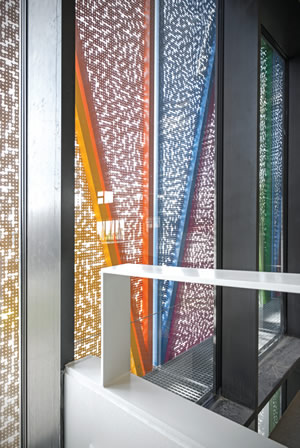
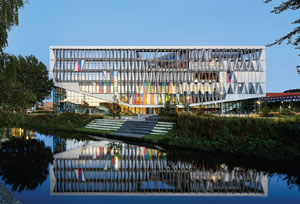
Designed by Henning Larsen Architects, the Kolding Campus building at the University of Southern Denmark is an example of an efficient, aesthetic lighting plan. Because maximizing available daylight is always a prime objective, the firm works to create façades that have a high level of transparency while simultaneously avoiding visual and thermal discomfort. A dynamic solar shading system, made up of more than 2,000 perforated steel shutters, wraps the Kolding structure. Controlled by sensors that measure light and heat levels, the shutters automatically open or close to regulate climate conditions inside the building. The result is a cascade of benefits: The wider the shutters open, the higher the transparency of the façade, the more daylight penetrates the building and the greater the views onto the surrounding cityscape — which helps the occupants of the academic facility feel connected to their place in the city.
PHOTOS © HUFTON + CROW
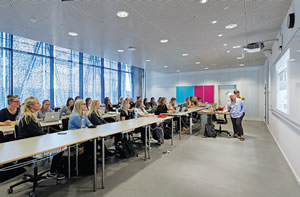
At Kolding, the classrooms and offices located directly behind the shuttered scrim have exterior walls of glass. To promote even greater penetration of daylight into these spaces, the architects designed an angled ceiling detail along the perimeter of each story, which captures and channels the maximum amount of sunlight into the rooms.
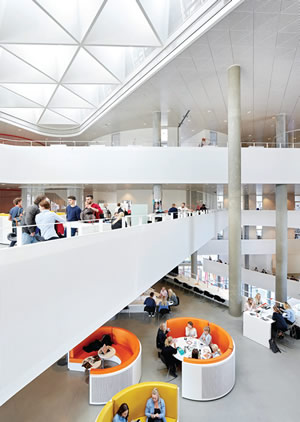
A large skylight above a central atrium brings daylight deep into the heart of the building, illuminating the open, informal study spaces that ring the atrium’s edges.
PHOTOS © HUFTON + CROW
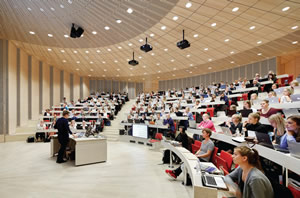
Of course, there are times — such as gloomy, overcast days or late-winter afternoons — when artificial lighting is imperative. The offices and classrooms at the University of Southern Denmark are equipped with integrated ceiling luminaires. These are clustered in zones and are wired to operate as a group when responding to real-time daylight conditions. This “daylight linking” requires computerized controls to ensure that the intensity and duration of electric illumination perfectly complements the available natural light.
PHOTOS © HUFTON + CROW
LET THE SUNSHINE IN. The use of light can enhance the creation of moods and atmosphere in learning environments. Highly energy-efficient windows, as well as advances in lighting design, can reduce the need for artificial lighting during daylight hours without causing heating or cooling problems. For the design of the Kolding Campus building at the University of Southern Denmark (seen on these pages), efficient LED lighting is used throughout, while photo-voltaics and solar-heating panels dramatically reduce the amount of energy taken from the grid. The façade consists of movable, triangular elements that regulate the inflow of light. Many of the classrooms and meeting areas have clear glass walls to maximize transparency and efficiently use natural light throughout the facility.
Like daylight, artificial lighting also influences students’ performance and requires a design strategy of its own. The design and positioning of luminaires must be carefully considered. Glaring or flickering lights cause visual discomfort, and, in turn, encourage unproductive behavior. Bright and blue-saturated light helps people maintain a better mood during the day, which enhances their ability to concentrate. On the other hand, dim, soft light decreases agitation and lessens conversation — attributes that can be important during group work or social time. Choosing light fixtures and controls that can be incrementally adjusted to suit the activity within the classroom is therefore important.
Recognizing this, Henning Larsen specified LED luminaires with a low glare index for the classrooms at the Kolding building. Subtle in appearance and output, they create a soft, even atmosphere that facilitates learning. The intensity of the fixtures can be manually adjusted, to support different activities. In addition, wall-washer fixtures are arrayed along each presentation wall, defining a focal point in the space through their relative brightness; skillfully lit, the wall becomes a literal bright spot in the room.
Beyond the classroom setting, informal learning spaces at Kolding are fitted with individual desk lights that can be operated by users, providing them with control over their immediate environment.
This article originally appeared in the issue of .