More Color Means More Flexibility in Learning
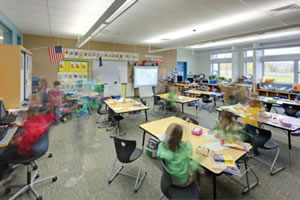
More color and better IAQ were two of the benefits Interface
offered designers at the Fred and Sara Machetanz Elementary School.
The Fred and Sara
Machetanz Elementary School
in Wasilla was the first school
in Alaska to receive the U.S. Green Building
Council’s LEED Certification, earning
silver. Backed by that honor, the school,
located in a former gravel pit and named
after a prominent Alaskan painter and
his wife, has emerged as a pioneer for
sustainability in the Matanuska Susitna
Borough.
Brought in by Anchorage-based
architectural firm McCool Carlson Green,
Interior Designer Cathy Kerr made sure
Interface was a component in the journey.
High-recycled content products contributed
to the more than 30 percent total
recycled content needed for the building
to achieve its LEED certification. Plus,
Interface products help maintain an
increased indoor air quality in the school
since tiles install —with no glue and meet
the highest standards for indoor air quality.
And then there’s the aesthetics. Kerr
carefully selected bold color combinations
to contrast against Alaska’s monochromatic
winter landscape while creating a
stimulating learning environment.
According to Kerr, there’s some science
behind the color scheme at this award
winning elementary school. “I designed the
interior of the school so that we used colors
from all the segments of the color wheel,”
she says. “We know that people respond
better in a full color spectrum environment.
Students learn more with color in
their environment as opposed to white
everywhere. So with that in mind I went
searching for the perfect carpet tile to do
that, and I found Interface.”
The result was an all around win, says
Mat-Su Borough Facilities Manager Don
Carney. “We liked the design so much that
we’re going to build two more using that as
a prototype.”
www.interface.com
This article originally appeared in the issue of .