Blinded by the Light
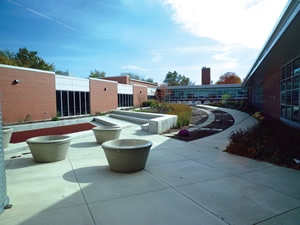
GARDEN HILLS ELEMENTARY SCHOOL, CHAMPAIGN, ILL. /PHOTO COURTESY OF DEJONG-RICHTER FROM CHAMPAIGN UNIT 4 SCHOOL DISTRICT
It’s the beginning of the school year, and the sun is shining
in most parts of the United States. Teachers
and kids would rather be
outside than in. Lately,
several clients have asked about creating
standards for outdoor learning spaces that
can be used when the weather cooperates.
Research from the University of Kansas
found that 120 adults who spent significant
time outdoors showed nearly a 50 percent
boost in creativity as measured by the Remote
Associates Test (Atchley & Atchley, 2012). The
researchers hypothesize that escape from the
near-constant buzzing, beeping and flashing
screens allows our brains to relax, and
relaxation is a foundation for
creativity. Before heading outside,
it’s a good idea to explore
the challenges and benefits of
nature’s original classroom.
Light and Vegetation
When you ask educators to name their
top requests for any learning environment,
natural light is always on the list.
But under what circumstances is being
bathed in natural light advantageous for
an outside learning environment, and under
what circumstances is it detrimental?
In general, natural light improves
a person’s ability to concentrate. Being
blinded by the light does not. Research
extoling the merits of outdoor spaces for
student learning and creativity mentions
“green spaces” and “natural settings”
and notes vegetation plays a significant
role in helping deliver behavioral and
cognitive benefits. A 2015 University of Illinois
study noted that young children on
playgrounds were much more likely to be
engaged in creative play and positive adult
interaction in play areas considered “high
vegetation” versus “low vegetation.”
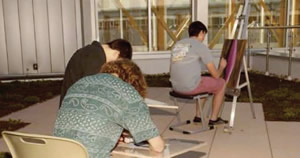
PHOTO COURTESY OF VIRGINIA BEACH CITY PUBLIC SCHOOLS
Top-level Art. Students at Kellam High School, in Virginia Beach, Va., put finishing touches on their
artwork in the art lab, situated on the school’s roof. The school’s roof also is designed to support and
grow vegetation, making it a green roof and a potential source for artistic inspiration.
Time and Money
The amount of effort and money spent
designing and equipping outdoor learning
spaces should be directly proportional to
the number of months each space can be
used comfortably. If your school district
resides in a part of the country where
temperatures soar and plummet regularly,
it’s best to make modest investments in
outdoor spaces. Choose materials that can
endure temperature swings and precipitation.
Durability and sustainability are
extremely important.
For example, combining a terraced
landscape with benches is a smart and
cost-effective way to create a small lecture
and performance space outdoors. As the
Atchley & Atchtley study suggests, unplugging
from the constant ping of electronic
environments can help adults and students
relax and work more creatively.
Not surprisingly, art instruction works
well in outside space. Students at Kellam
High School in Virginia Beach make art on a
roof that grows vegetation, serving as both a
green roof and a well-lit teaching space.

Design Guide. There are numerous examples
of transformed outdoor learning spaces in the
Schoolyard Design Guide, which was published
by the Boston Schoolyard Initiative. While that
organization officially closed its doors at the end
of 2013, they continue to maintain their website,
www.schoolyards.org, which contains a multitude
of information, research and where you can
download the guide in PDF format.
Acoustics and the Open Concept School
One of the reasons the 1970s open concept
school failed nationwide was acoustics.
It’s hard to engage a class and keep a
class engaged when speakers and listeners
can’t hear each other.
Loud, distracting noises have the same
affect outdoors. That’s why outdoor learning
spaces should include natural barriers such
as shrubbery to pass the acoustic test: Can
speakers and listeners comfortably and effectively
engage in normal speaking voices?
Pedagogy
A discussion-based class and a projectbased
class function very differently
indoors compared to outdoors. Requirements
(power, plumbing, etc.) and adjacencies
(proximity to science or art rooms)
must be considered for outdoor learning
spaces just as they are for indoor spaces.
The most commonly requested outdoor
learning area is an amphitheater, a space
well suited for performances and presentations.
However, if pedagogy continues to
shift away from lecture-based teaching,
what do you do with an amphitheater,
other than have it host performances? Consider
small amphitheaters instead. They’re
more flexible than large amphitheaters and
can be created for minimal cost.
Model Use
Using the four considerations above,
outdoor learning spaces shouldn’t require
highly specialized equipment or be
cost-prohibitive. Outdoor spaces should be
comfortable places that meet the Goldilocks
principle for temperature and light—not
too high, not too low. The Schoolyard Design
Guide created by the Boston Schoolyard
Initiative provides insightful ideas and a
helpful design checklist for outdoor learning
spaces. Though primarily dedicated
to play spaces, the guide includes valuable
information about fencing, landscaping, site
furniture, public art and green practices.
Designing successful outdoor learning
spaces requires the same basic considerations
as successful indoor environments. People learn best when their environments
meets their basic human needs, letting them
focus on the task at hand. Finding the right
balance of light, temperature and acoustics
as well as the right furniture and landscaping
lets students and teachers escape their
four walls. The outdoors is calling!
This article originally appeared in the issue of .
About the Author
David Sturtz has more than a decade of experience as a teacher, administrator, educational entrepreneur and strategic planner. He has overseen the instruction of thousands of students, and he has hired and managed hundreds of teachers and supplemental instructor. Today, David serves as a project director for DeJONG-RICHTER a leading school facility planning firm. Both David and the firm are members of the Council of Educational Facility Planners International (CEFPI).