From MEH to WOW
1. “Resist the urge to add more light to increase safety. The uniformity of the lighting rather than the intensity is what contributes to a person’s sense of wellbeing in an area, and high-quality LED luminaires can provide superior uniformity. I’d suggest administrators work with a qualified lighting designer to inherently minimize areas of contrast by achieving as even a spread of light as possible across the area. The light we see striking vertical surfaces, known as ‘good vertical illuminance,’ is also critical as it allows us to identify people’s faces rather than, say, just their shoes as they are walking toward us or past a video surveillance camera on a dark night. A strategic blend of uniformity and vertical illuminance can put peoples’ minds at ease in public areas.”
— Dean Dal Ponte, vice president brand management, architectural outdoor, Hubbell Lighting
PHOTOS COURTESY OF FANNING HOWEY
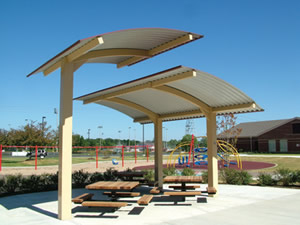
2. “Picnic tables for schools now function not only for outdoor dining areas but also for informal outdoor classroom seating and desks, so there are a number of considerations in making a purchasing decision. Surfaces are key: Will the tables be used primarily for dining where sanitation and easily cleaned surfaces are required, or will they be used for writing in outdoor classroom settings where smooth, easily maintained surfaces are required? Consider accessibility for handicapped students. Consider climate and sun control by the use of solid or fabric shading, especially in warmer climates. Ask if it’s important to include charging stations and WiFi capability for electronic devices. Finally, as durability and material selection are important considerations, ask if the tables will be in public areas where constant vandalism could occur, or if they be used in secure, supervised courtyard spaces.”
— Jeff Bolinger, RLA, landscape architect with the Indianapolis office of Fanning Howey, an architecture and engineering firm specializing in learning environments
3. “Your campus has a profound effect on the quality of life of whatever neighborhood you support. Each school day your neighbors are bearing the burden of your operations, whether that means unimaginable traffic congestion during morning assembly or afternoon dismissal or the constant onslaught of passing bells or the din of children at play during recess. Don’t let your night lighting decisions become one more intrusion. Instead, when planning for outdoor lighting, consider your neighbors’ sightlines to your campus: Walk around your community at night and get a feel for which angles will affect the least number of neighbors as possible.”
— James P. Gonsalves, CFM, SFP, zone manager, San Diego (Calif.) Unified School District, and president, IFMA’s Academic Facilities Council
4. “Lighting design must ensure adequate illumination to support safe pedestrian travel through your campus and employee safety. Entrances to the main offices, buildings and restrooms should be clearly illuminated. Adequate lighting of paths, walkways and outdoor work areas like lunch courts, dumpster areas and can-washing enclosures helps keep custodians and maintenance workers safe while working well into the night.”
— James P. Gonsalves, CFM, SFP, zone manager, San Diego (Calif.) Unified School District, and president, IFMA’s Academic Facilities Council
PHOTOS COURTESY OF FANNING HOWEY
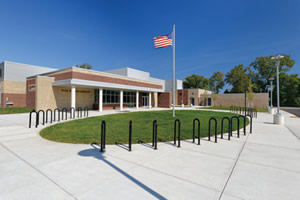
5. “Both location and aesthetics are important to consider when planning for bicycle racks at your new k-12 building. Near the main entrance, just outside of the primary pedestrian circulation route is a popular placement location. The children and bicycles are in a high visibility area and a safe distance from vehicles. When possible, leave room for additional racks in case there is a future building expansion. The color and style should match the aesthetics of adjacent benches and trash receptacles when possible. Children should always be encouraged to walk their bikes to the racks once on school property.”
— Andy Cihla, ASLA, landscape architect, with the Dublin, Ohio, office of Fanning Howey, an architecture and engineering firm specializing in learning environments
6. Consider vinyl-coated chain-linked fencing because, not only is the life cycle of the fence extended, but it also offers the safety, security and durability of traditional chain-linked fencing while blending into the surrounding environment, creating a more pleasing school environment.
— Robert Cervi, executive director of Construction Management & Facilities, Austin (Texas) Independent School District.
This article originally appeared in the School Planning & Management September 2018 issue of Spaces4Learning.