Direct-Attach Ceiling Panels Improve Acoustics
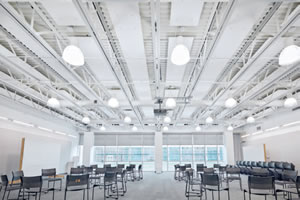
Armstrong’s Tectum Direct-Attach acoustical panels cut down on excessive reverberation times in Temple University’s School of Architecture.
The acoustics in Temple University’s School of Architecture building in Philadelphia were exhibiting excessively high reverberation times, affecting students’ ability to hear and understand their instructors. Acoustical testing by Metropolitan Acoustics of Philadelphia confirmed that reverberation times were much longer than recommended.
Consultant Graham Everhart explains how his team created models based off the testing to develop solutions. “Our overall recommendation was to incorporate acoustically absorptive materials on the available surfaces,” he states, “and in most spaces, the most available surface was the ceiling, so we focused on that.”
The consultants then worked with NELSON, the architectural firm responsible for the remedial retrofit project. “Considering the amount of hard surfaces, from an open metal deck to drywall walls to concrete floors, it was easy to see why sound bounced around so quickly,” notes Scott Winger, AIA, technical director for NELSON.
To reduce reverberation time and improve speech intelligibility, the design team chose Optima Capz ceiling panels from Armstrong Ceiling Solutions for the lecture halls and other presentation spaces. The panels were installed directly to the deck.
Tectum Direct-Attach acoustical panels from Armstrong were chosen for the classrooms and studios. “Tectum and Capz panels perform in a similar manner acoustically, but we went with the Tectum panels here because we thought they were a little more rugged and better suited for these types of spaces,” Winger states. These panels were also installed directly to the deck.
Acoustical testing following installation of the ceiling panels validated the choice of treatments. Reverberation time dropped an average of 56 percent in the eight spaces that were tested, including a 79 percent drop in one of the classrooms and a 64 percent drop in one of the studios.
www.armstrongceilings.com
This article originally appeared in the College Planning & Management January/February 2019 issue of Spaces4Learning.