Frictionless Parking: Promoting Campus Public Health During This Pandemic
In recent years many colleges and universities
have turned to frictionless parking to better manage campus
parking facilities. By combining unique focused parking solutions
into complete suites that can make it easier to get in and
out of parking garages, universities can make parking more user-friendly for students, faculty, and staff. The same solutions
make parking lots and garages easier to manage and, combined
with the frictionless parking benefits that students and staff enjoy,
are very attractive to universities.
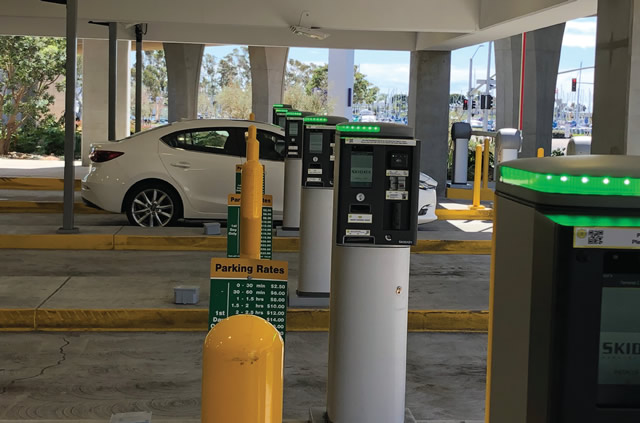
But now, during this public health crisis, frictionless parking can
promote public health by dramatically reducing the number of common
touch-points within a garage or parking lot. These touch-points
are particularly common in equipment that handles payments or issues
tickets. We don’t give a second thought to pressing the buttons
on parking payment equipment or on find-my-car kiosks. We’ve done
it so many thousands of times that it has become second nature. But
someone using that equipment isn’t the only person pushing those
buttons. Chances are, many people have already used that equipment,
and there’s no way to know whether it has been contaminated.
Frictionless Parking to the Rescue
That’s where frictionless parking comes in. The technology
trend to which many colleges and universities have already
turned to improve the parking experience can also reduce the
hazard of common touch-points in parking facilities.
With frictionless parking, drivers can enter garages without
stopping to take a ticket, are directed to available parking
by parking guidance systems, and are automatically charged
through one of a number of different payment methods from
apps on a phone, registering on a website with the plate number
to scanning the barcode. Universities also often offer permits to
students, staff, and faculty, and the equipment can also administer
permit programs from the universities website which obviates
the need to visit a parking office. When it’s time to leave,
the driver merely returns to his or her vehicle and exits the facility.
There are no delays at pay-on-foot kiosks or exit booths.
Nor are there screens for parking patrons to touch when paying.
Frictionless parking begins with PARCS technology offering
connectivity with any of a wide range of other types of technology,
including mobile payment tools, Bluetooth Low Energy
(BLE), License Plate Recognition (LPR) tools, and bar code
readers, and RFID technology.
Typically, when a driver enters a parking facility offering frictionless
parking, that driver’s credentials are recognized by the system
and associated with a payment account or permit. This can happen
in a number of ways. In some facilities LPR equipment records
the driver’s information and associates the vehicle with his or her
credential. In others, RFID technology recognizes visitors’ parking
lease tags, employee badges, drivers’ licenses or other identification
cards, admitting authorized drivers to parking facilities or specially-designated areas within a parking facility. BLE systems, on the
other hand, recognize Bluetooth signals from cell phones and other
Bluetooth enabled devices to identify drivers. All of these approaches
limit the driver’s physical contact with the parking equipment.
When the driver is ready to leave the facility, the system again
recognizes the driver and charges his or her card (or recognizes
if the driver has a permit). When payment is satisfied, the gate
opens and the driver is able to exit the facility. Once again, when
the driver leaves, he or she doesn’t have to touch any equipment.
Public Health Benefits
In recent years, many colleges and universities across the United
States have added frictionless parking technology. For those campus
parking facilities, the technology is already in place to protect
parkers and staff. In those cases, campuses should be reaching out
to students, faculty, and staff, as well as any transient parkers who may use the garages, to explain the public
health benefits of frictionless parking
and encourage them to utilize the equipment.
Typically, this is just a matter of
parkers creating an account associated
with the frictionless system, associating
the account with their license plate or
permit tag, and inputting a credit card
or permit number. Then, as they drive in
and out of parking facilities the system
will do all of the work, and they don’t
have to stop to pay or touch equipment.
For colleges and universities that
don’t have frictionless parking, now
may be the time to install it. Even after
this public health crisis is over, it will
continue to reduce the risk to students,
faculty, and staff during future cold and
flu seasons, not to mention if there are
future pandemics. Plus, the equipment
will continue to pay dividends by creating
a much better user experience and
enhancing parking management. The
utilization data that’s collected by the
various PARCS and guidance technology
provides a valuable and accurate
snapshot of how the equipment is being
utilized. This is invaluable information
for improving parking management.
The Future of Parking
Hopefully, the coronavirus crisis
will be over soon, but the public health
implications of the common touchpoints
that are often present in parking
facilities will continue to be an important
concern. Even if the novel coronavirus disappears once this pandemic plays itself out — and that’s certainly far from a
certainty with many experts predicting its seasonal return — we are still subjected
to the flu and other viruses every year. The new reality of parking is that we need to
eliminate as many common touchpoints as possible, and frictionless parking can be an
important part of a campus parking public health strategy.
This article originally appeared in the March/April 2020 issue of Spaces4Learning.
About the Author
Chris McKenty is vice president of SKIDATA. He can be reached at [email protected].