 RIT Saunders College of Business – Lowenthal Hall Addition
 RIT Saunders College of Business – Lowenthal Hall Addition
 RIT Saunders College of Business – Lowenthal Hall Addition
 RIT Saunders College of Business – Lowenthal Hall Addition
 RIT Saunders College of Business – Lowenthal Hall Addition
 RIT Saunders College of Business – Lowenthal Hall Addition
 RIT Saunders College of Business – Lowenthal Hall Addition
 RIT Saunders College of Business – Lowenthal Hall Addition
Project Information
Facility Use: Higher Education
Project Type: Renovation
Category: Whole Building / Campus Design
Location: New York
District/Inst.: Rochester Institute of Technology
Chief Administrator: Michael Dellefave, Director Construction/Project Management
Completion Date: 02/29/2024
Gross Area: 38,000 sq. ft
Area Per Student: 6.3 sq ft.
Site Size: 0.6 acres
Current Enrollment: 2,000
Capacity: 600
Cost per Student: $43,333
Cost per Sq. Ft.: $684.2
Total Cost: $26,000,000
A Forward-Looking Tribute
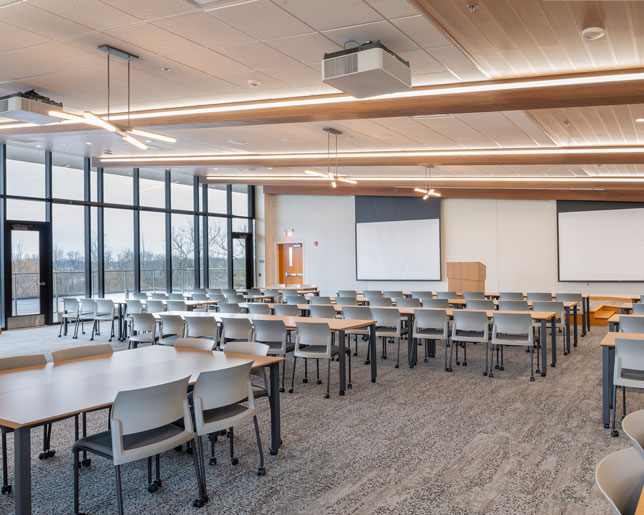
The Lowenthal Hall addition at the Rochester Institute of Technology's Saunders College of Business fulfills its mission as both a learning environment and a lasting architectural legacy. The 38,000-square-foot design elevates RIT's business school by nearly doubling its footprint and delivering dynamic, state-of-the-art spaces tailored to next-generation education. From classrooms, collaboration spaces, and lounges to an auditorium, food venue, event space, and outdoor terraces—every design decision is rooted in context and innovation and reflects a commitment to user experience, flexibility, and quality.
The goal of the project was to create a sensitive addition that seamlessly blends with the existing building and its context while incorporating abundant natural light and adding program space that meets the needs of contemporary students and teaching pedagogies. The project also included renovations to modernize learning and lounge spaces, introducing flexible furniture, multiple teaching walls, and refinished classrooms that replaced exposed concrete masonry unit with improved acoustics and a warmer atmosphere.
LaBella's architectural team balanced reverence for the original 1970s structure with a contemporary vision. The process began with a thorough study of the existing building, examining its varied façade treatments and complex circulation. With floors at -5', 0', and +5', connectivity to the addition was a tricky endeavor, and floor-to-floor heights even more so.
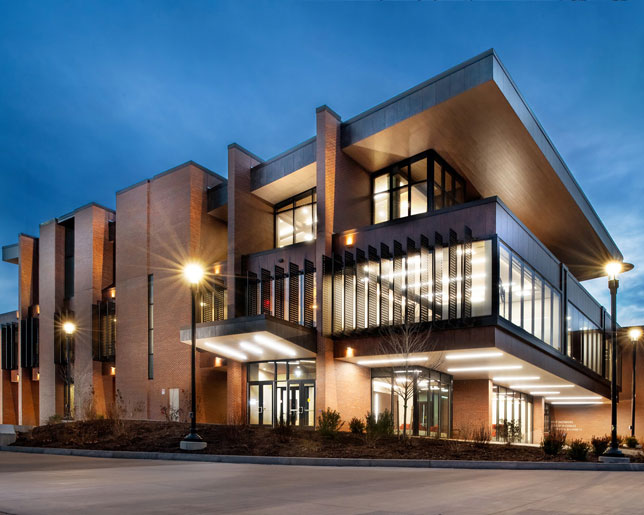
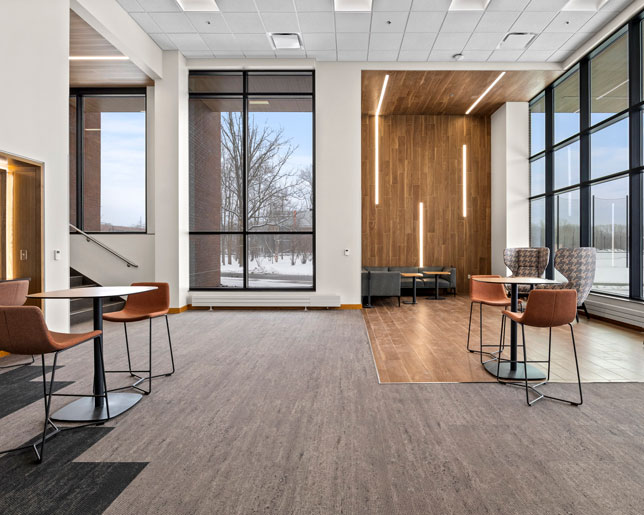
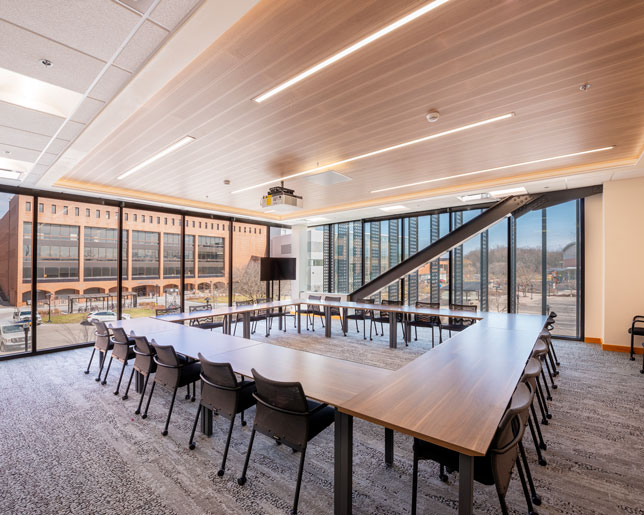
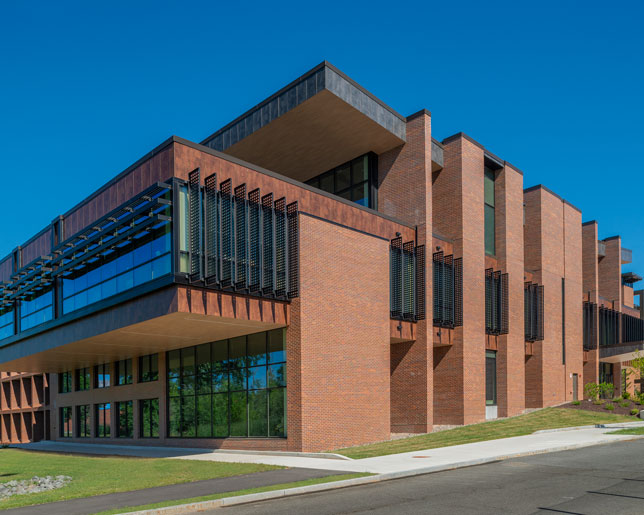
The addition's rhythmic brickwork, deeply set windows, and exposed concrete elements pay homage to the adjoining Modernist aesthetic. A horizontal volume of differing materiality "pierces" the vertical brick piers, cantilevering north and south to create sheltered spaces below. This volume houses a program that demanded views and light, both of which are abundant at the perimeter of this glassy volume. A cast concrete stair and balcony reference the exposed board-formed concrete in the 1970s building. The oak tones of the original wood ceiling inspired the linear metal wood-look ceiling in the addition. A three-story ceramic tile feature wall creates a powerful visual anchor, enhancing wayfinding and identity within the space.
To balance the existing structure's limited exterior windows, the addition maximizes glazing to introduce transparency, light, and warmth. Thoughtful, refined, high-performance materials present acoustic, thermal, and visual benefits. Cantilevered rooftop patios and proximity to wetlands connect the building to nature.
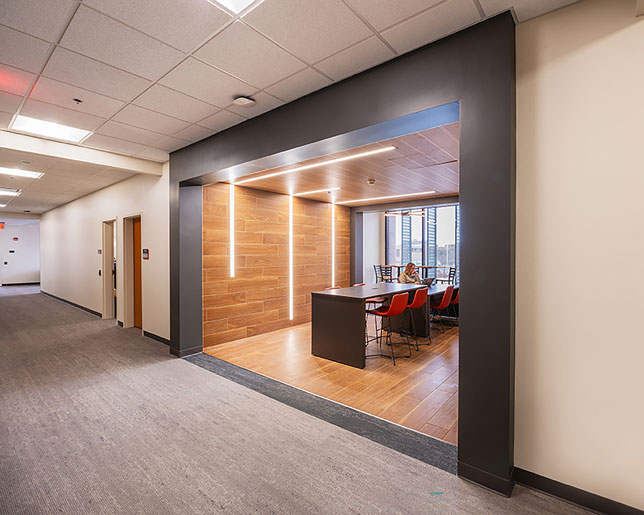
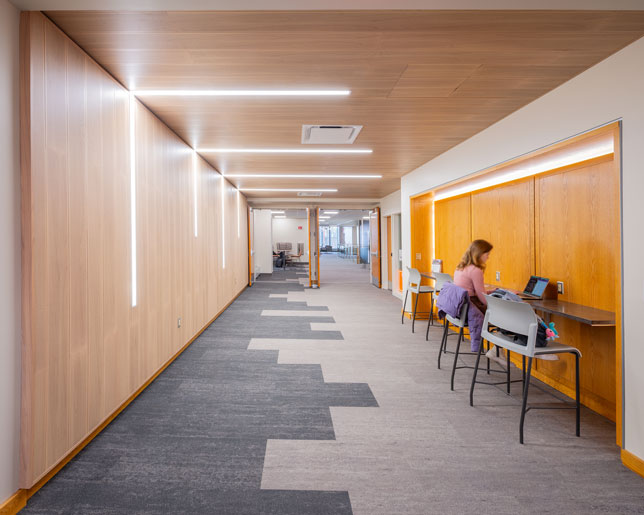
Classrooms feature multiple teaching walls and reconfigurable furniture, supporting evolving pedagogies and next-generation learning, while "creative collision" zones provide niches for individual or group work. The design encourages interaction and movement through open floor plans, visible staircases, and circulation loops that link all four levels.
Occupant Wellness
The addition integrates WELL design principles to promote occupant health and wellness, focusing on movement, acoustics, light, and mental health. "Racetrack" circulation paths encourage movement and improve wayfinding, while rooftop patios and views of adjacent wetlands promote a deep connection to nature. Acoustic partitions reduce noise distractions. Natural light is thoughtfully incorporated into learning spaces to minimize glare and visual distractions. Sun-shading devices provide thermal comfort while preserving visible light transmittance and connection to the outdoors, delivering spectacular views of the surrounding landscape.
By prioritizing movement, comfort, natural light, and a strong connection to nature, the design creates an enriching environment that nurtures both the physical and mental well-being of its occupants.
Energy Efficiency & Sustainability
Through energy-efficient strategies and thoughtful use of natural light, the building exceeds energy codes and minimizes its environmental footprint while creating a healthier, more comfortable space for its occupants.
The addition echoes the original building's deep brick recesses while incorporating significantly more glass, enhancing transparency and maximizing natural light to foster a vibrant learning environment. A solar study was central to this approach, revealing that morning sunlight would strike the east façade—the largest expanse of windows—before shifting south throughout the day. This analysis informed the building's massing, glazing selection, and passive shading strategies. Deep recesses within the building massing block direct sunlight as it moves across the east façade, while a cantilevered third floor and large roof overhang mitigate heat gain on the south. Ceramic fritting and a low-E coating minimize ultraviolet and infrared light transmission into the building, easing demand on mechanical cooling systems. Custom sun-shading louvers on the east and south façades feature a perforated pattern that further reduces solar exposure and casts dazzling shadows inside.
The building's unique solar design and massing not only enhance energy efficiency and occupant comfort but also serve as an example of environmentally conscious design in the community.
Safety
The original building remained open during construction, so the safety of staff and students was imperative. Signage and partitions kept the public clear from work zones. A temporary entrance was created while the original entrance was demolished to maintain sufficient egress and intuitive circulation. Given the building's location in the campus's academic core, the team took care when bringing in and operating cranes and equipment to avoid campus disruption and maintained an access fire lane to ensure emergency vehicles could reach the campus interior if needed.
The plaza near the building entry sits adjacent to the campus' primary pedestrian thoroughfare and occasionally serves as an access route for service vehicles. The final design of the plaza considers this complex circulation and ensures clear visibility throughout the area, supporting pedestrian safety.
Innovation & Contribution to the Industry/Community
By expanding the college's footprint by 80%, the project delivers modern, flexible spaces that elevate the student, faculty, and community experience while serving as a model for adaptive campus growth.
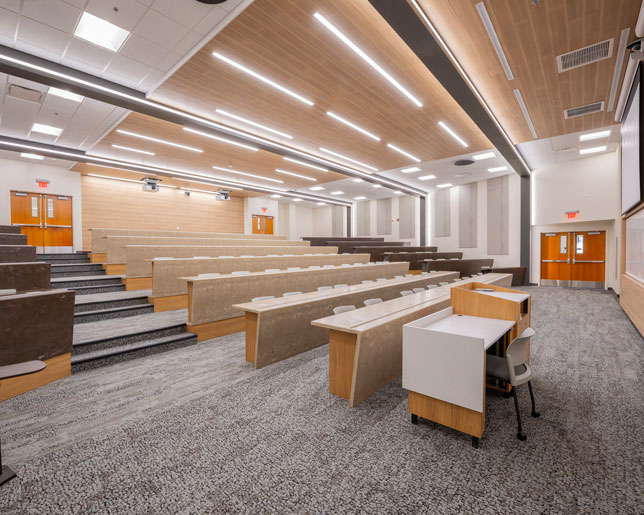
The project strengthens the community by creating a dynamic hub for interdisciplinary collaboration and public engagement. New spaces, like the Susan R. Holliday Center and Gueldenpfennig Auditorium, bring together students, faculty, alumni, and regional leaders for conferences, lectures, and events.
Challenges
The design of the Lowenthal Hall addition launched in March 2020—just as the COVID-19 pandemic reshaped the world and forced the project team into remote work overnight. Architects, engineers, and RIT stakeholders rapidly adapted to a fully virtual collaboration model, including video conferencing, screen sharing, and live digital markup tools to review sketches and design concepts. Despite these constraints, the team maintained momentum without delays, quickly building a remote workflow that was both effective and efficient.
As the pandemic continued, the project faced widespread industry challenges, including volatile material pricing and supply chain disruptions which introduced significant cost pressures, threatening the project budget. The design team, construction manager, and RIT leadership shared a commitment to maintaining project goals and quality. Through a transparent value engineering process, they collectively evaluated and implemented strategic design modifications that preserved programmatic intent, architectural integrity, and the user experience.
The north side of the existing 1970s building has two floors; the south side has three. Because of the design challenge this split-level condition posed, much of the early design work stemmed from circulation diagrams. Ultimately, the team leveraged the elevation change within the tiered auditorium to span between two "half levels" and created openness (a balcony and two open stairs) to further communicate between them. This continuation of the existing corridors eliminated dead-end conditions and improved wayfinding.
Legacy and Innovation
Lowenthal Hall exemplifies how educational design can be both contextual and forward-thinking—embracing a rich architectural legacy while setting new benchmarks for sustainability, wellness, and academic innovation. It stands as a model for future campus development and a catalyst for continued growth and impact in the greater Rochester region.
Architect(s):
LaBella Associates